Fill a glass at your kitchen tap in Jaipur and look at it against the light. It probably looks perfectly clear. Yet the kettle has a white crust, your soap barely lathers, and the new RO purifier tastes oddly flat. Clear water tells you almost nothing. The numbers do.
Most households buy a purifier first and test later, if ever. This guide flips that order. You’ll learn how to measure two things at home, what the readings mean, and how to decide between an RO, a softener, or both. Once you know your TDS level in Jaipur water at your own address, you stop guessing and start choosing.
TDS and Hardness Are Not the Same Thing
People use these two terms as if they mean one thing. They don’t, and mixing them up is the most common reason homes end up with the wrong equipment.
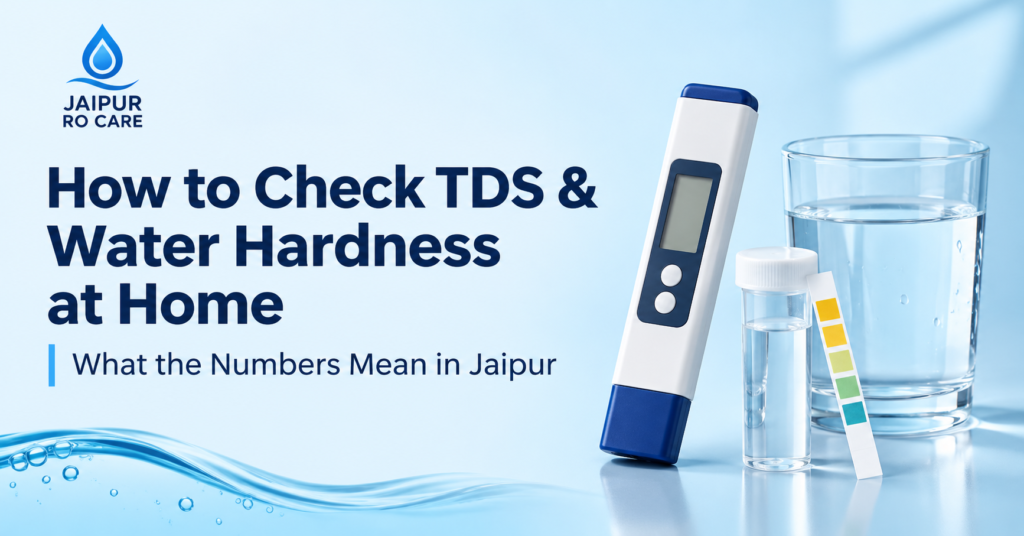
TDS (total dissolved solids) is the total amount of everything dissolved in your water: calcium, magnesium, sodium, chloride, sulphate, nitrate and more. A TDS meter reads electrical conductivity and converts it into an estimate, so it cannot tell you your hardness, because it counts all conductive ions and not only the calcium and magnesium behind hardness.
Hardness is a narrower measurement. It counts only calcium and magnesium, the minerals that leave scale in pipes, geysers and kettles and stop soap from foaming.
Here’s the catch. Two waters with identical TDS can differ wildly in hardness, and softened water barely changes in TDS because a softener swaps calcium for sodium. So a low TDS reading doesn’t prove soft water, and an unchanged TDS after installing a softener doesn’t mean it failed.
| TDS | Hardness | |
| What it counts | All dissolved minerals and salts | Calcium and magnesium only |
| Typical symptom | Salty or bitter taste | Scale, dull hair, poor lather |
| Home tool | TDS meter | Hardness test strips or drop kit |
| Fixed mainly by | RO purifier | Water softener |
Why Jaipur Water Deserves a Closer Look
Jaipur leans heavily on groundwater. An India Water Portal report based on NEERI and PHED data describes how about 90% of the city’s drinking water demand relies on groundwater, with Ramgarh Lake supplying the remaining 10%. The same report notes that the local aquifer is rich in calcium, magnesium, chloride, sulphate and nitrate, and these ions push up TDS, hardness and alkalinity. In its treatment-level samples, TDS was well above the 500 mg/l permissible level.
The pressure on supply has only grown. A 2023 study points out that the Central Ground Water Board classed all 13 zones of Jaipur city as “dark zones”, with the water table falling about 25 metres in a decade. A deeper, more over-drawn aquifer tends to carry more dissolved minerals.
Treat that as a pattern, not a verdict on your tap. Water can differ between a borewell, a PHED connection and an overhead tank, even within one colony. That’s why measuring at your own tap beats relying on city averages.
How to Test at Home: TDS Meter and Hardness Strips
You need two inexpensive tools. For a basic TDS meter, one Indian guide puts the cost at roughly ₹200 to ₹800. Hardness strips are cheap and widely sold online.
Testing TDS with a meter
- Run the tap for 30 seconds to flush standing water.
- Fill a clean glass. Rinse it first, since leftover soap or detergent skews the reading.
- Switch the meter on and dip the probe to the marked line.
- Wait until the number stops moving, then note it down.
- Repeat for your RO or filter outlet if you have one.
Testing both the raw tap and the purified water shows whether your purifier is still earning its place. A purifier output that creeps upward over time often means the membrane is tiring.
Testing hardness with strips
- Collect a fresh sample in a clean cup.
- Dip a strip for the time on the pack, usually a second or two.
- Wait the stated time, then match the colour pad to the chart.
- Do it in daylight, because indoor lighting makes colour matching unreliable.
Strips are quick, but they give a range, not an exact figure. One review points out the drawback is lower accuracy and the need to compare colours against a chart, which can feel subjective.
A free pre-check: the soap test
Shake a little pure soap with water in a closed bottle. Heavy cloudiness with weak foam hints at hard water. It’s only a hint, but it costs nothing.
Reading the Numbers: Two Simple Charts
India’s standard for drinking water, IS 10500:2012, sets TDS at 500 mg/L as the acceptable limit and 2000 mg/L as the permissible limit when no better source exists. For total hardness, the same table lists 200 mg/L acceptable and 600 mg/L permissible.
TDS ranges (mg/L or ppm)
| Reading | What it usually means | What to do |
| Below 50 | Very low minerals, flat taste | Common from RO output; consider a mineraliser |
| 50–150 | Pleasant, light taste | Nothing needed |
| 150–500 | Within the BIS acceptable limit | Basic filtration or UV may do |
| 500–900 | Above the acceptable limit; an RO purifier with a TDS controller is advised | RO recommended |
| 900–2000 | Poor taste, above the acceptable limit | RO needed; check hardness too |
| Above 2000 | Beyond even the permissible limit | Get a professional test before drinking |
Hardness ranges (as CaCO₃, mg/L)
| Reading | Category |
| 0–60 | Soft |
| 61–120 | Moderately hard |
| 121–180 | Hard |
| Above 180 | Very hard |
Hard-water scale builds up quietly inside geysers, washing machines and pipes. Soft readings rarely need action.
Which Result Points to Which Solution
Once you have both numbers, the decision gets much simpler.
| Your result | Likely problem | Best solution |
| High TDS, high hardness | Heavy mineral load plus scale | Softener first, then RO |
| High TDS, soft water | Salts without scale | RO purifier |
| Moderate TDS, high hardness | Scale and soap trouble | Water softener |
| Low TDS, soft water | Mineral content is fine | Basic UV/UF, if microbes are a concern |
| Meter and strips disagree | Mixed or unusual water | Professional test |
Why softener before RO? Hard water scales an RO membrane quickly, shortening its life. Removing hardness upstream protects the membrane and keeps the purifier running well for longer.
Also note a limit: UV and UF purifiers work best when TDS stays low. One brand guide says UV and UF purifiers suit areas with TDS up to about 200 mg/l, while RO handles high-TDS water up to around 1000 ppm. In much of Jaipur, that points toward RO. If your numbers show hardness as well, our softener page explains how the two systems work together.
Why a Professional Test Is More Accurate
Home testing is a good first step, and you should absolutely do it. But it has real limits.
- A TDS meter is an estimate. It can’t name which minerals are present.
- Strips give ranges. The difference between 150 and 220 mg/L can change which system you need.
- Neither detects what matters most. Fluoride, nitrate, iron and bacteria all slip past a TDS meter. Fluoride contamination, for instance, has been flagged in Central Ground Water Board notes on Jaipur district.
- TDS can look fine while other problems hide. One guide warns against assuming low TDS means safe water, or ignoring hardness, arsenic, fluoride and bacteria because TDS looks acceptable.
A professional visit tests the source and the point of use, compares borewell, supply line and tank, and reads hardness precisely. The advice that follows is based on your water, not on a brand brochure. If you’d like to see how this works, our TDS and hardness testing service page explains what we check.
Book Your Free On-Site Test
If your meter says one thing, your strips say another, or your numbers are simply high, don’t spend on equipment yet. Our team will visit, test your water on the spot, and tell you plainly whether you need an RO, a softener or both. Even if the answer is “neither”, you’ll know for sure.
Book your free on-site TDS and hardness test in Jaipur →
Keep your home readings handy. Comparing them with our results is a nice way to see how close a home test gets.
5 Quick FAQs
1. What is a safe TDS for drinking?
Under BIS IS 10500:2012, 500 mg/L is the acceptable limit. Up to 2000 mg/L is permissible only when no better source exists.
2. Can a TDS meter tell me if my water is hard?
No. It measures all dissolved ions, not just calcium and magnesium. Use hardness strips or a titration kit.
3. Is very low TDS bad?
Not unsafe, but it tastes flat and carries few minerals. A mineraliser can help if your RO output is very low.
4. How often should I test?
Test the raw tap once, then your purified water every month or two. Retest whenever the source changes, such as a new borewell or tank.
5. Do I need both an RO and a softener?
If both TDS and hardness are high, usually yes. Softening first protects the RO membrane.