If you live in Jaipur, you already know the struggle — white stains on your bathroom tiles, slippery soap lather that never quite rinses off, a funny taste in your drinking water, and maybe an expensive geyser that’s calcified from the inside. Jaipur’s water is dominated by high concentrations of calcium, magnesium, TDS, and hardness — often above permissible limits. And yet most homes keep buying one machine and expecting it to solve everything.
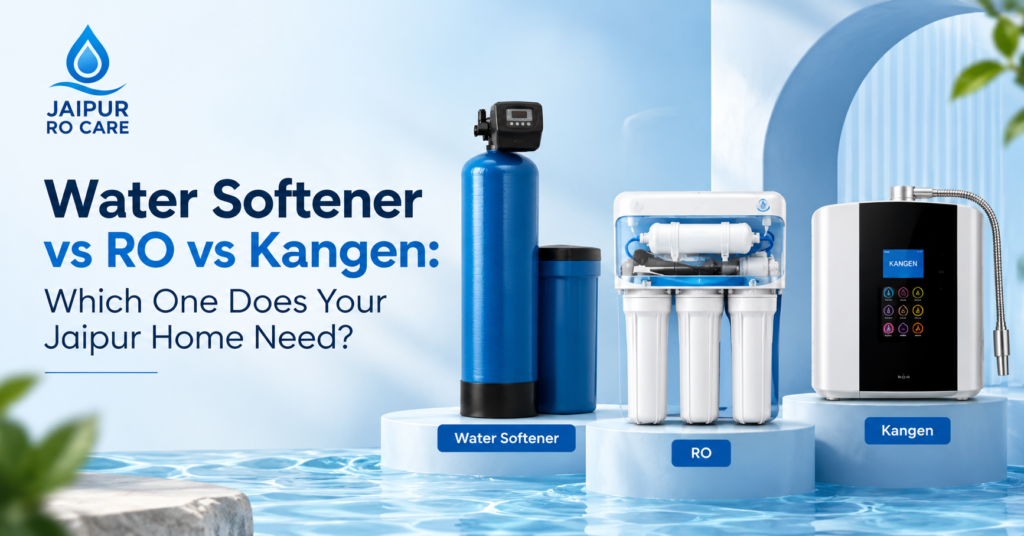
The truth? A water softener, an RO purifier, and a Kangen machine solve three completely different problems. Installing the wrong one — or the right one in the wrong order — is money wasted.
Here’s an honest, no-jargon guide to help you decide.
The Three Problems You’re Actually Trying to Solve
Problem 1: Drinking Water Safety
Your body needs water that is free from excess TDS, heavy metals, bacteria, chlorine, and dissolved salts. In Jaipur, typical water TDS ranges from 600–1000 ppm, making RO + UV mandatory for safe drinking water. No softener or ionizer alone can handle this.
Problem 2: Hard Water for Bathing, Washing & Appliances
Hard water (loaded with calcium and magnesium) damages your geyser coils, leaves scale inside washing machines, dries out your hair and skin, and wastes detergent. This is a water softener’s job — and it’s meant to work at the inlet, treating water for the whole house.
Problem 3: Alkaline or Ionised Water for Wellness
Some people — especially those focused on antioxidant intake, hydration, or specific health goals — look at Kangen (alkaline ionised water). This is a specialised want, not a basic necessity. A Kangen machine is meant to be the last layer in your water setup, placed after purification is already done.
Quick Comparison: Water Softener vs RO vs Kangen
| Feature | Water Softener | RO Purifier | Kangen Machine |
| Primary job | Removes hardness (Ca/Mg) | Removes TDS, bacteria, metals | Ionises and alkalises water |
| Treats whole house? | Yes (inlet-level) | No (point-of-use, kitchen) | No (point-of-use, kitchen) |
| Removes TDS? | No | Yes (85–95% reduction) | No |
| Makes water drinkable? | Not alone | Yes | Only after RO pre-treatment |
| Protects appliances? | Yes | No | No |
| pH of output water | Neutral | Slightly acidic (6.5–7) | Alkaline (8–9.5) |
| Best placed at | Main water inlet | Kitchen point-of-use | After RO output |
| Approx. cost (India) | ₹15,000–₹35,000 | ₹8,000–₹25,000 | ₹1.5L–₹4L+ |
| Maintenance | Salt refill every 6–8 weeks | Filter change every 6–12 months | Electrode cleaning periodically |
The Recommended Setup Order for Jaipur Homes
Getting the sequence right is as important as getting the right machine. Here’s the correct flow:
Inlet → Water Softener → RO Purifier (Kitchen) → Kangen Machine (Optional, after RO)
Why this order?
- Softener at the inlet protects your geyser, pipes, washing machine, and overhead tank from scale build-up.
- RO in the kitchen brings TDS down to a safe 150–250 ppm range for drinking and cooking.
- Kangen after RO ensures the ioniser is working on already-clean, low-TDS water — which is critical (more on that below).
Sample Home Setups: What Does Your Home Actually Need?
2BHK Flat (Municipal Supply, 600–800 ppm TDS)
Problem: Hard water causing scale in geyser and washing machine. Drinking water TDS above safe limit.
Recommended setup:
- Water softener at the main inlet
- RO purifier under the kitchen sink
- Optional: Kangen SD501 or similar after the RO output
Skip if: Your TDS is below 500 ppm — a UV+UF system may be enough for drinking water; check with a free test first.
Villa or Independent House (Mixed Supply + Overhead Tank)
Problem: Larger family, multiple bathrooms, borewell water at 800–1200 ppm, appliances suffering badly.
Recommended setup:
- High-capacity water softener (whole-house, pre-tank)
- Commercial-grade RO for kitchen (higher output, larger membrane)
- Kangen machine only if family has a wellness-focused reason — run it exclusively on RO-treated water
Borewell House (Suburban Jaipur, 1000–2000 ppm TDS)
Problem: Extremely high hardness, water tastes brackish, skin feels rough, white deposits everywhere.
Recommended setup:
- Heavy-duty water softener at the borewell outlet
- High-TDS RO (look for systems rated for 2000 ppm input)
- Avoid running Kangen directly on borewell water (see common mistakes below)
- Add a sediment + carbon pre-filter before the softener if water is visibly turbid
Common Mistakes Jaipur Homeowners Make
Running a Kangen machine directly on high-TDS water
This is the single biggest mistake we see. Kangen machines use electrolysis to ionise water — but when TDS is already above 400–500 ppm (as it often is straight from Jaipur taps), the ioniser struggles to separate water effectively, the electrodes wear faster, and output quality drops. Always pre-treat with RO before connecting a Kangen machine.
Buying a softener thinking it will make water safe to drink
A softener removes hardness minerals — it does not remove TDS, bacteria, pesticides, or heavy metals. Softened water from the tap is not drinking water. You still need an RO for that.
Skipping the softener and relying only on RO for the whole house
RO is a point-of-use device — it treats a small volume for drinking. Running hard water through your geyser and washing machine without a softener means costly repairs every 2–3 years.
Buying the most expensive Kangen model without RO first
Some Jaipur homeowners invest ₹3–4 lakhs in a top-end Kangen machine without any pre-treatment. The result: the expensive ioniser runs on 900 ppm hard water, electrode plates corrode faster, and the pH output becomes inconsistent.
Never testing your water
Two homes in the same neighbourhood, even on the same borewell line, can show noticeably different TDS and hardness readings. Don’t copy your neighbour’s setup — test your own water first.
FAQs
Q1. Do I need a water softener if I already have an RO purifier?
Yes, for different reasons. Your RO handles drinking water; your softener protects appliances, geysers, and your skin while bathing. They are not substitutes for each other.
Q2. Can I use a Kangen machine without an RO?
Not recommended in Jaipur. Kangen machines need input water with low TDS (ideally below 300 ppm) to ionise effectively. Jaipur’s tap water TDS is 600–1000 ppm — always pre-treat with RO first.
Q3. What TDS level is ideal for drinking water?
The BIS standard recommends 500 ppm as the permissible limit, with 300 ppm preferred. After a good RO system, output is typically 150–250 ppm — ideal for daily drinking.
Q4. How often should I change RO filters in Jaipur’s hard water?
More frequently than average — typically every 6 months for sediment and carbon pre-filters, and every 12–18 months for the RO membrane. A softener upstream significantly extends your RO membrane’s life.
Q5. Is Kangen water scientifically proven to be healthier?
The health benefits of alkaline ionised water are still debated in scientific literature. That said, many users report better hydration and taste. What is clear is that it must be consumed fresh (ionisation is temporary) and only from pre-purified water.
Get a Free Water Hardness Test for Your Jaipur Home
Before you invest in any system, know what’s actually in your water. Jaipur RO Care offers a free hardness test at your doorstep — so you can make an informed decision rather than guessing.
Whether you need just an RO, a softener + RO combo, or a complete three-stage setup with Kangen, our team will recommend only what your water — and your budget — actually needs.
Book your free water test today at jaipurrocare.in